
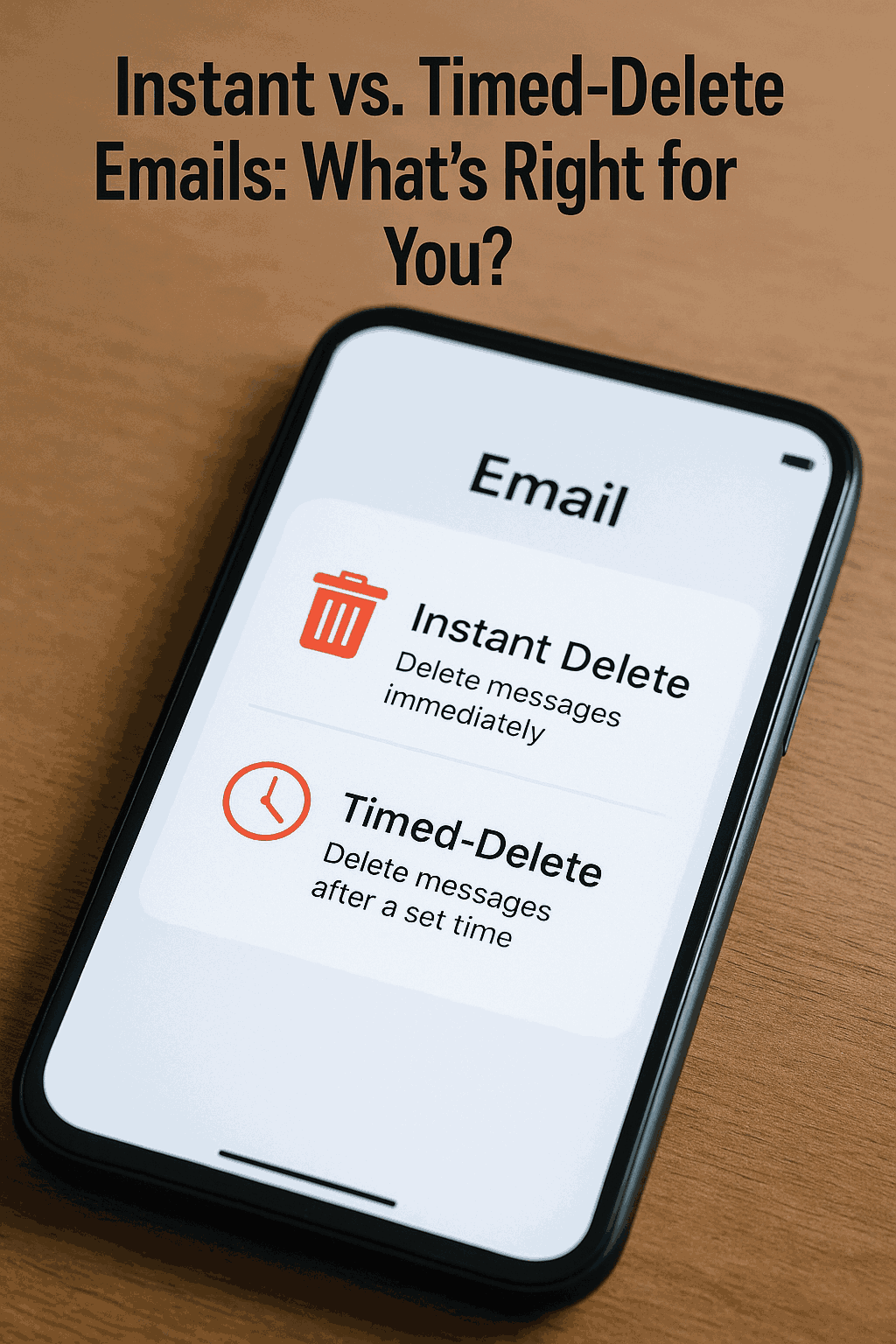
Instant vs. Timed-Delete Emails: Which Self-Destruct Option Fits You Best?
Instant vs. Timed-Delete Emails: What’s Right for You? ⏳📨
Picture this: You scribble a note on paper, read it once, and then set it on fire immediately. 🔥 That’s instant-delete email—gone the moment it’s opened.
Now imagine you write another note, slip it into a drawer, and set a timer so it self-destructs tomorrow, next week, or next month. ⏰ That’s timed-delete email—messages that vanish automatically after a set period.
Both approaches help protect your privacy, but they’re not interchangeable. To decide which is right for you, you need to understand how they work and when each shines.
The Appeal of Self-Destructing Emails
We live in a world where every word we type can linger forever—stored on servers, forwarded, screenshotted, or hacked. Self-deleting emails promise a little relief: the comfort of knowing your words won’t live longer than you want them to.
But like choosing between a speedboat and a cruise ship, you need the right tool for the right trip. 🚤🛳
Instant-Delete Emails: Blink and It’s Gone ⚡
An instant-delete email disappears as soon as the recipient opens it. It’s the digital equivalent of whispering a secret and then sealing your lips forever.
Examples in Action:
You share a one-time login link with a teammate. They open it, use it, and the email vanishes.
A company sends you a secure verification code. Once used, there’s no reason for it to hang around.
The Upside: Maximum privacy. Even if someone tries to search later, the trail is gone.
The Downside (Correction): If the recipient accidentally closes their email or forgets the details, they can’t retrieve it. Unlike timed-delete emails, there’s no grace period.
Best Use Cases:
Authentication codes
Password reset links
Highly sensitive one-time information
Timed-Delete Emails: Privacy on a Clock ⏲️
A timed-delete email stays put until a countdown runs out. Think of it like a parking meter: you have a limited window to use it, and when time’s up, it’s gone.
Examples in Action:
You send a confidential report to a client and set it to auto-delete in 7 days. Enough time to read and act, but not enough to linger in archives.
A teacher shares exam instructions with students, programmed to disappear the day after the test.
The Upside: Flexibility. Recipients have a fair window to review information, but it won’t remain forever.
The Downside (Correction): Some providers only enforce deletion inside their own ecosystem. If the recipient forwards the message outside, it may persist. Always confirm your service’s rules before relying on timed-deletion.
Best Use Cases:
Business contracts or proposals
Temporary project files
Sensitive communications with an expiration date
Which One Fits You Best?
Choosing between instant and timed-delete is a bit like deciding between a sticky note and a calendar reminder:
Instant-delete = sticky note: quick, useful, tossed immediately.
Timed-delete = calendar reminder: still temporary, but designed to last just long enough to be useful.
If your priority is maximum security and zero traces → instant-delete wins.
If you want convenience and a safety buffer for readers → timed-delete is the better fit.
The Iceberg Mail Advantage 🧊
With Iceberg Mail, you’re not forced to choose one or the other—you can set emails to self-destruct instantly or schedule deletion with a timer that fits your workflow.
That means:
Instant-delete for one-time secrets ⚡
Timed-delete for short-lived but important conversations ⏲️
Full control over how long your words live in someone else’s inbox
It’s like having both a lighter and an hourglass at your desk—ready to burn or fade your messages on your terms. 🔥⏳

