
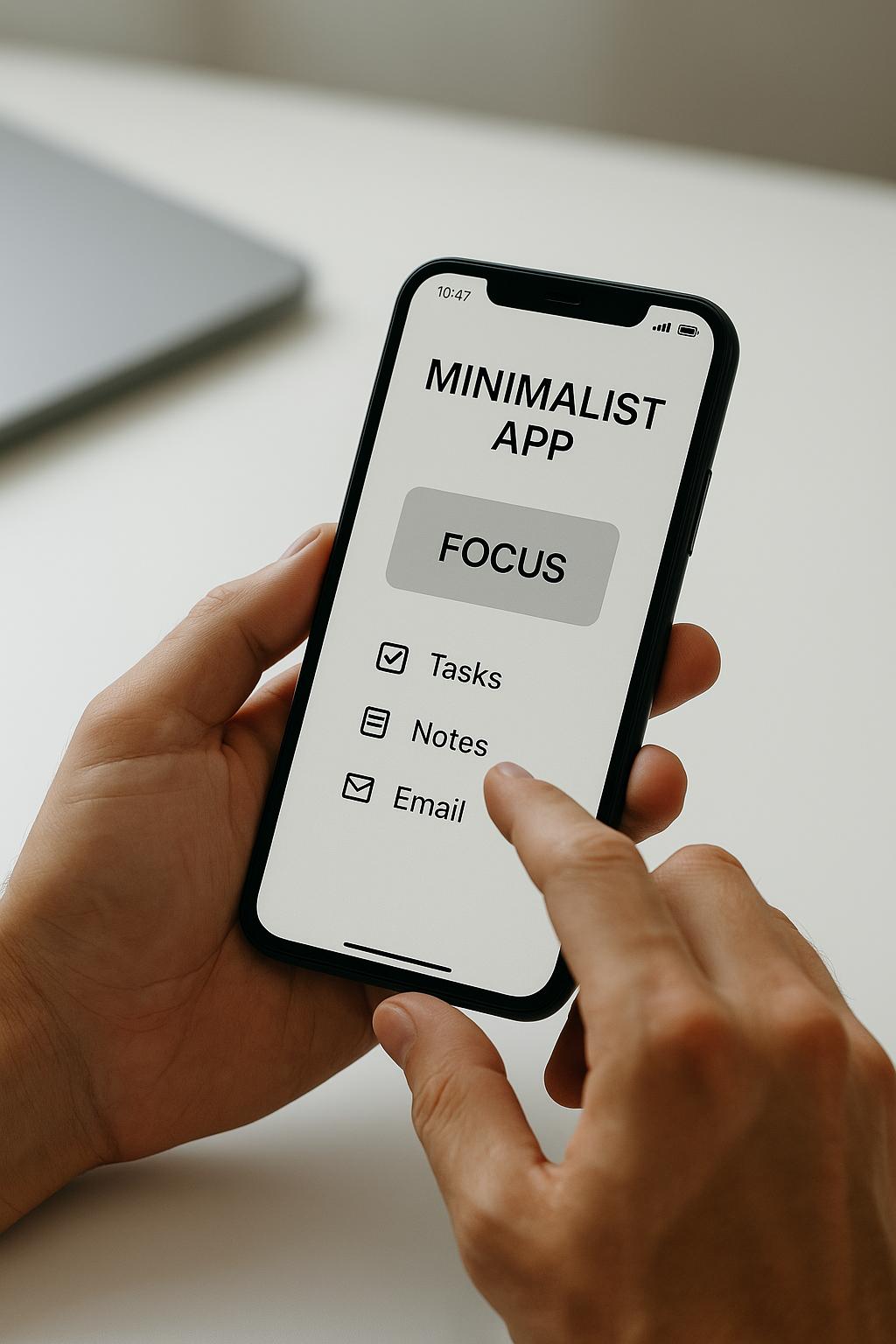
Why Minimalist Apps Are Dominating 2025: Focus, Privacy, and Productivity
Minimalist Apps Are Taking Over in 2025 — Here’s Why 🧘♂️📱
Our digital lives are noisier than ever. Think about it—between endless push notifications, banner ads blinking at you like neon signs, and pop-ups that demand clicks before you can even read what you came for, the online world can feel like walking through a crowded marketplace where everyone is shouting your name.
That’s why in 2025, more people are turning to minimalist apps. These aren’t stripped-down toys; they’re focused, clutter-free tools designed to give you space, clarity, and control. In a world where digital overwhelm is the new normal, simplicity is becoming a superpower.
🌱 The Power of Minimalism in Tech
Minimalist apps work like a clean, organized desk. Instead of papers stacked in every corner, pens scattered everywhere, and sticky notes covering your screen, everything has its place. You sit down, take a deep breath, and focus.
They cut away the noise so you can focus on what matters—the work, the message, the task at hand.
👍 The Benefits of Minimalist Apps (With Real-Life Examples)
1. Increased Focus 🎯
No flashing ads, no notification chaos—just you and the task.
Example: A writer using a minimalist note-taking app like Obsidian or Bear gets a blank canvas—no sidebar clutter, no pop-up tips. Just words flowing onto the page.
2. Faster Load Times ⚡
Minimalist apps often skip the heavy scripts, animations, and bloated features that slow things down.
Example: Instead of waiting 15 seconds for a dashboard stuffed with graphs to load, a minimalist task manager opens instantly—helping you add a task before you even forget it.
3. Better Privacy 🔒
Many minimalist platforms pride themselves on not tracking your every move. Less clutter usually means fewer ads and data grabs.
Example: A privacy-first browser with a clean UI won’t follow you around the web with “that pair of shoes you looked at once.” Instead, it lets you browse distraction-free.
4. Streamlined Design 🧩
With minimalism, everything is right where you expect it. No digging through menus or hunting for buttons.
Example: In a minimalist calendar app, adding an event takes two clicks—not ten. You see only your schedule, not endless options for weather, trending events, or “suggested tasks.”
5. Less Mental Fatigue 🧘♀️
Every extra button, banner, or popup is a micro-decision your brain has to process. Minimalist apps remove those distractions, saving mental energy.
Example: Think of using Iceberg Mail: no banner ads flashing at the top, no sidebars asking you to upgrade, just you and your inbox. You finish email in half the time, with half the stress.
👎 The Trade-Offs of Minimalist Apps
Of course, minimalism has its limits. It’s not always perfect—sometimes the simplicity comes at a cost.
Fewer Features: Advanced users may miss niche tools.
Learning Curve: If you’re used to busy dashboards, clean designs may feel “too empty” at first.
Limited Customization: Some apps trade flexibility for simplicity.
Fewer Integrations: Not every minimalist tool plays nice with third-party apps.
Example: A minimalist project tracker might keep you focused, but power users could feel frustrated if it doesn’t integrate with their favorite CRM or automation tool.
🧊 Minimalism in Action: Iceberg Mail
Minimalism in tech isn’t just about how apps look—it’s about how they work.
Take Iceberg Mail. Unlike traditional inboxes filled with banner ads, promotional tabs, and pop-ups, Iceberg Mail gives you only what you need: your messages.
It’s like walking into a quiet library instead of a noisy shopping mall—you can finally read, write, and reply without distractions.
🚫 No banner ads.
🧩 No unnecessary features.
✨ Just a clean, private space to focus on email.
✅ Bottom Line
Minimalist apps aren’t just a design trend in 2025—they’re a movement toward digital sanity, productivity, and privacy.
By removing the clutter, they give us something more valuable than features: clarity.
👉 Experience what minimalism feels like in your inbox—try Iceberg Mail and enjoy email without the noise.
Your digital life doesn’t need more features. It needs less clutter. 🧊✨

